

ENDGAME: Maxing performance while keeping low node specs
Welcome back, anon.
In our previous articles, we've explored MegaETH's real-time capabilities, compared our performance to Web2 apps, and established what "real-time" actually means in blockchain.
We even launched a game that lets you feel real-time performance:
Today, though, we're revealing how we can make that performance possible while maintaining low hardware requirements for the network: node specialization.
Come along.
ARTICLE TLDR
- Traditional blockchains are inefficient: every node redundantly does everything. This design bottlenecks performance and excludes smaller participants.
- MegaETH splits responsibilities across four specialized node types.
- High-powered Sequencers build blocks; lightweight Provers and Replicas ensure correctness and Full Nodes offer maximum trust by re-executing blocks, but aren't required for participation.
- Result: 10ms blocks, massive throughput, and broad accessibility without sacrificing decentralization.
THE PROBLEM WITH TYPICAL BLOCKCHAINS
Traditional blockchain networks have a fundamental bottleneck: every node performs all actions. Consensus, execution, validation, and storage all happen redundantly across the entire network. Using a real-world analog; that'd be like having a company where the CEO, managers, and interns all perform identical tasks – not exactly a model of efficiency.
This monolithic approach creates two massive problems that limit scalability.
- Redundancy kills throughput when every node repeats identical work across the network.
- Pushing performance higher means hardware requirements skyrocket, pricing out smaller participants and reducing the number of nodes which can participate in the network.
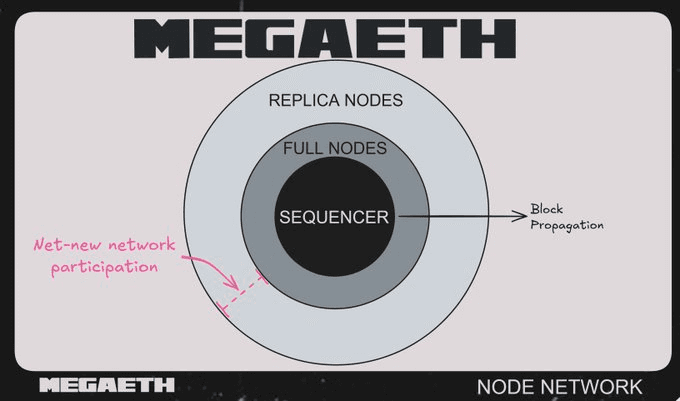
To visualize the relationship, you can view the network as concentric circles where the block building center (validator/sequencer) creates a block in the center and is attempting to propagate it the edges of the broader circle.
The size of that next circle will be dictated by how hard it is to run the machine to keep up with the block builder. The bigger the builder, the more expensive it is.
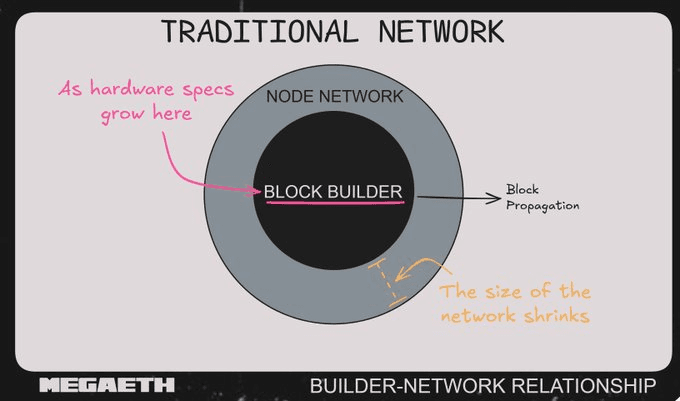
Even the fastest chains today struggle with this problem because they have to wait for full nodes to completely re-execute new blocks to verify correctness and stay in-sync with block producers.
This re-executing node is what you interact with, and what block producers must ensure they don't work too fast for, or the whole network slows. Therefore, blockchains are constrained by their slowest component under the traditional paradigm.
Therefore, blockchains are constrained by their slowest component under the traditional paradigm.
THE MEGAETH APPROACH
We've implemented an architectural design based on principles of low-latency systems engineering.
Instead of every node doing everything, we've employing four distinct node types, each focusing on its specific task. This division allows us to achieve a combination of performance and decentralization that is impossible with traditional blockchain architectures.
The key insight is that not all blockchain operations need the same hardware, and not all participants have the exact requirements. By acknowledging these differences and building them into our architecture, we can optimize for the best of both world.
Let's step back and look at the two designs from a high level.
MegaETH vs Traditional Network
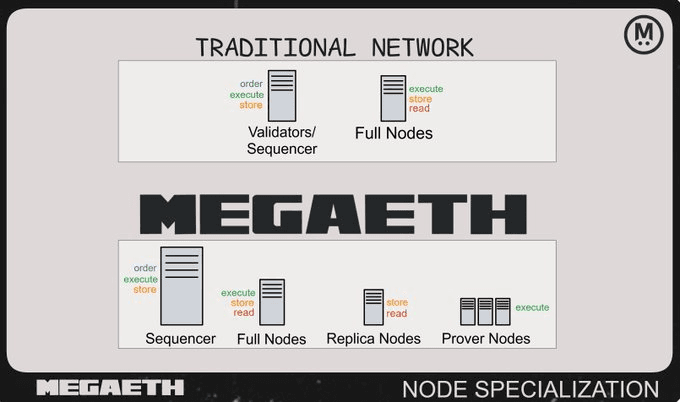
A node comparison of MegaETH to traditional blockchain networks
Relative Node Specifications
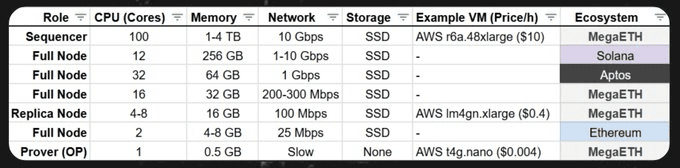
Relative node specifications of MegaETH versus popular networks
As you can see, there is a bit more variety in our setup due to our specialized approach, allowing network participation below that of even Ethereum.
Next, let's talk about the role of each and how they collectively make a stronger whole.
NODE BREAKDOWN
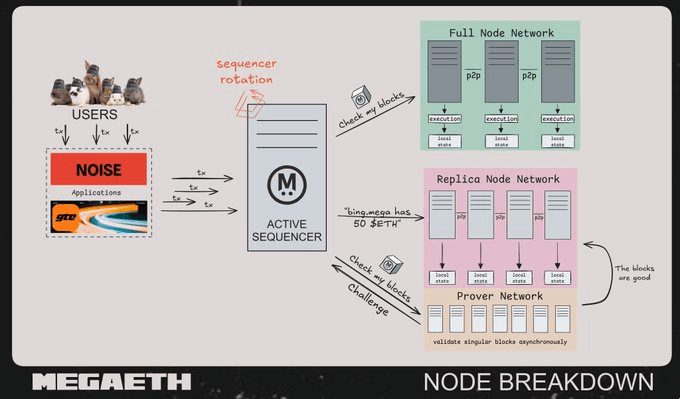
An overview of all node relationships within the network
Sequencer Node (block builder)
At the heart of our architecture is the Sequencer—a monster machine that would be near-impossible to run residentially: 100 Cores, 1-4 TB Memory, and 10 Gbps Network. It orders and executes transactions in real-time, acting as the central processor for MegaETH's state updates.
One of the Sequencer's most radical innovations is that it can hold the entire blockchain state in RAM. This minimizes I/O bottlenecks, which allows the Sequencer to process transactions at speeds approaching centralized databases, enabling our signature 10ms block times.
To mitigate the censoring and liveness risks of a single block builder, the Sequencer will also rotate amongst a set—enhancing its decentralization properties while never introducing consensus performance overhead.
After execution, the Sequencer then sends state diffs to Replica Nodes, Blocks to Full Nodes, and Blocks + Witnesses to Prover Nodes.
PROVER-REPLICA DEPENDENCY
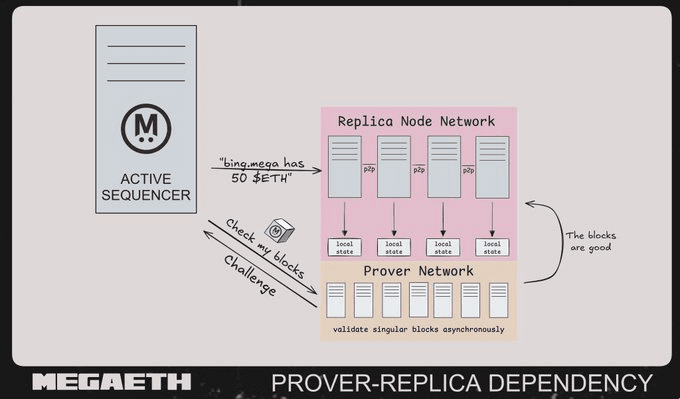
Focusing on the key relationship between prover and replica node networks
Prover Nodes
While the Sequencer continues processing transactions, Prover nodes work asynchronously in the background, generating cryptographic proofs of full blocks received from the Sequencer.
This step is to ensure that the Sequencer has not produced any blocks with invalid or malicious transitions, forwarding their proof of good behavior on to Replica nodes. We will cover why in the next section.
The beauty of this separation is that Provers don't need to keep pace with the Sequencer in real-time. They can work on generating proofs at their own pace, dramatically reducing their hardware requirements. Prover Nodes need just 1 Core, 0.5 GB Memory, and minimal network requirements. This lightweight design opens up participation to everyone. Running a Prover node costs pennies per hour on cloud infrastructure, or can be done on modest hardware at home.
Replica Nodes
This is where expanded network participation happens for most users and applications.
Instead of re-executing every transaction (which creates the bottleneck in traditional chains), Replica Nodes simply apply state diffs from the Sequencer to update their copy of the blockchain. Then, they leverage the proofs generated by the Prover network to ensure the state diffs are correct without doing the heavy computational lifting of re-execution.
For most use cases, Replica Nodes provide all the benefits of a full node with a fraction of the computational, bandwidth and monetary requirements.
Full Nodes
For those who demand maximum trustlessness, such as market makers, exchanges, and security-critical applications, Full Nodes remove reliance on any external party. They re-execute every transaction independently to verify the Sequencer's work without relying on cryptographic shortcuts, maintaining a trustless, fully verified state.
The trade-off for this is that Full Nodes have higher hardware requirements than either Replica or Prover nodes: 16 Cores, 64 GB Memory, and 200 Mbps Network.
While this is more than chains like Arbitrum (their Full Nodes run on 4 Cores and 16GB Memory) you'll note that it's less than several performance-minded chains like Solana and Aptos due to some low-level techniques we've deployed.
Even still, MegaETH can push our full node requirements higher because we've lowered the barriers to entry for Prover and Replica Nodes.
Bringing this back to our opening visualization, you can see how our concentric circle is able to make our block builder a large machine, pulling in the secondary circle of full nodes but still growing the overall network with our Replica-Prover node combination.
SUMMARY
MegaETH's architecture delivers efficiency by eliminating redundant work across the network. Doing this enables throughput multiples beyond "normal" blockchain performance (1.7 Gigagas/s throughput, 10ms block times) without ballooning node requirements and network participation.
The thing to note here is that this isn't just a technical implementation—it's our philosophical approach to scaling and provides a structural advantage against competitors seeking to "turn up the dial" on performance.
With a roadmap targeting 10+ Gigagas/s and 1ms block times, we're building for a future where blockchain isn't just a clunky coordination layer, but also an expressive, real-time environment.
Build with us.

Published: 05/14/2025