

ENDGAME: How MegaETH bridges throughput and decentralization
Here's the problem with blockchains: the faster you make them, the harder it is to prove they're following the rules (e.g. to validate them). This problem shines brightest for high-performance chains, which oft leads to a tradeoff: you either have high throughput OR accessible validation, but not both. Producing high throughput demands larger machines (read: hardware requirements), which in turn makes network validators data center operations.
So intuitively, given its throughput is ~70x higher than the top live EVM chains, one would assume MegaETH is extremely expensive to validate.
One would be wrong.
MegaETH keeps validation accessible to anyone with a laptop and a basic internet connection.
How? Stateless Validation—our approach to verifiability that requires zero state storage and minimal hardware requirements.
The Problem: Big Throughput == Big(ger) Box
MegaETH is fast. Very fast, actually, because we're combining novel efficiency gains (new database structure [SALT], parallelism, removed gas limits, JIT compilation, etc) with thicc machines.
How thicc? Data center-grade:
- 100+ cores
- 1TB of RAM
- 4TB SSD storage
- 10 Gbps networking.
Even our highly-optimized full nodes, which leverage auxiliary data from the sequencer to re-execute transactions more efficiently, still demand enthusiast-grade machines:
- 16-core processors
- 64GB of RAM
- Similar storage + networking requirements as the sequencer.
To give some disparity perspective, here is a comparison of the above, competing high throughput validators (Solana) and your average laptop:
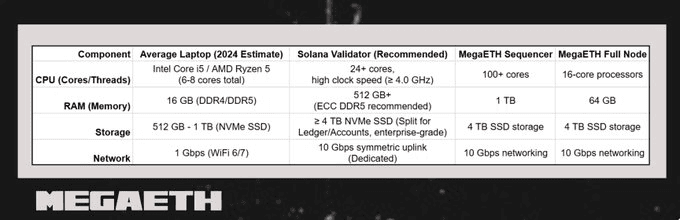
That disparity between machines is what we had to solve for.
Any given user should have the power trustless check that the system is following the rules.
True decentralization can’t rely on workstation-class machines with terabytes of storage. Validation must remain lightweight enough for anyone to run, without specialized hardware.
The Solution: Stateless Validation
This is where Stateless Validation comes in: shifting the burden away from the storage and compute required for validation of high capacity chains.
Stateless validators only need to check that each new block is valid against the previous state—using a small set of additional data and lightweight proofs.
A comparison:
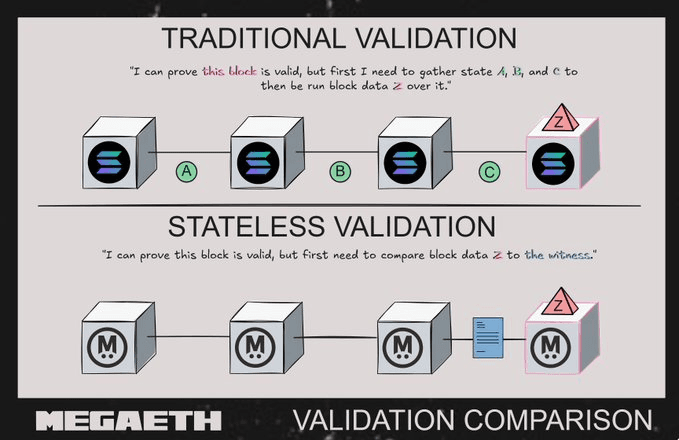
Comparing traditional, stateful validation to MegaETH's stateless model where the sequencer is generating cryptographic proof of all prior block data so that the validator need only the witness (blue) and the current block data to verify it's validity
The key insight is that you don't need to use a whole map of the world to verify that a specific route from point A to point B is valid; you just need someone to provide you with that portion of the map, and then verify yourself that the roads connect correctly.
Here's how it works:
The MegaETH sequencer provides stateless validators with a "witness," a cryptographic proof that contains only the small pieces of state data necessary to execute a specific block's transactions.
Stateless validators then use the witness to:
- Verify that the provided state data is authentic
- Execute the block's transactions using this verified data
- Compute what the new state root should be
- Confirm it matches what the sequencer claims
If everything checks out, the new block is validated. If not, it's rejected.
Let's walk through an example.
Say Alice has 10 ETH, Bob has 5 ETH, and Alice wants to send 2 ETH to Bob.
Starting Point:
The previous block header contains a state root hash (think of this as the cryptographic representation of the entire blockchain state). Validators trust this root because it was already verified in the previous block.
STEP 1: The Witness Arrives
To validate Alice's transaction, stateless validators receive specific pieces of information from the sequencer:
- Alice's account (balance = 10 ETH)
- Bob's account (balance = 5 ETH)
- Merkle proof paths for both accounts connecting to the previous state root
This is the witness—pieces of data relevant to the transaction.
STEP 2: Verification
Stateless validators take the account data + proof paths (witness), then hash them step-by-step up the tree to compute a state root. If the result equals the trusted previous state root, the data provided by the sequencer is authentic. If they don't match, the new block gets rejected immediately.
This step mathematically proves that the account balances received from the sequencer are correct.
STEP 3: Execution
Using the verified account balances, stateless validators execute the transaction (Alice → Bob: 2 ETH):
- Alice: 10 ETH → 8 ETH
- Bob: 5 ETH → 7 ETH
STEP 4: Computing the New State Root
Stateless validators re-hash the updated accounts back into the tree structure and compute the new state root.
STEP 5: Final Verification
If the stateless validators' computed state root matches what the sequencer claimed for the new block, the block is valid. The validators have confirmed the correctness of the state transition without accessing, storing, or writing any state data.
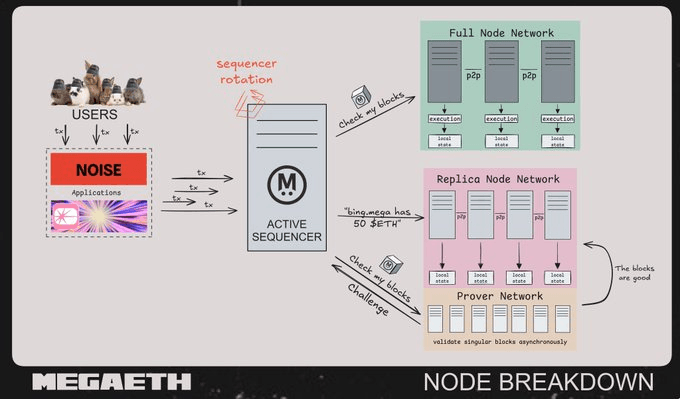
While the above is not a computationally heavy exercise for singular machines, MegaETH takes this further by distributing validation amongst a network of nodes, with each stateless validator checking only a portion of new blocks. This significantly reduces bandwidth and computation for any given validator.
Here is an image from our node specialization article to showcase the network topography and where the prover network resides:
The Hardware Requirements
The result of the aforementioned decisions is an elimination of state storage and increase in network parallelization, reducing stateless validation requirements to:
- 2 CPU cores
- 1 GB RAM
- 0 storage - witness data is kept in RAM
- Slow network
Compare this to traditional validation of a high-throughput chain, which requires:
- 16+ CPU cores
- 32+ GB RAM
- 4TB+ SSD storage
- 10+ Gbps network
Solana Validator Requirements
Dual Client Validation with Pi Squared
But again; we didn't stop there and pushed the setup further with a second stateless implementation. This makes our optimized execution even more sound by proving block validity through multiple, independent approaches.
That's why we're partnering with @Pi_Squared_Pi2 to enable day-one dual-client validation on MegaETH.
UNDERSTANDING PI SQUARED
Consider this: typically, blockchains have a specification (documents that describe what should happen) and implementations (actual code, such as Reth). These may not always match perfectly, leading to potential bugs and client disagreements.
Pi Squared's breakthrough is the LLVM-K, a specialized compiler that transforms mathematical specifications of programming languages into high-performance executable code. Think of it as turning precise mathematical equations into fast-running programs.
The most powerful demonstration of this approach is through the KEVM, a complete mathematical specification of the EVM (Ethereum's Virtual Machine) written in the formal language K. Unlike traditional EVM implementations, which may have subtle differences or bugs, KEVM is mathematically identical to the official EVM specification.
Here's where the magic happens: LLVM-K compiles the KEVM specification (written in K's mathematical semantics) into efficient native code ahead of time. This compiled KEVM executable is then deployed across Pi Squared's FastSet Network, giving FastSet Verifiers the ability to check the correctness of EVM executions with mathematical precision.
This sets up MegaETH for Day 1 dual-validation architecture, adding safety and putting it ahead of ~all chains not named Ethereum. (!)
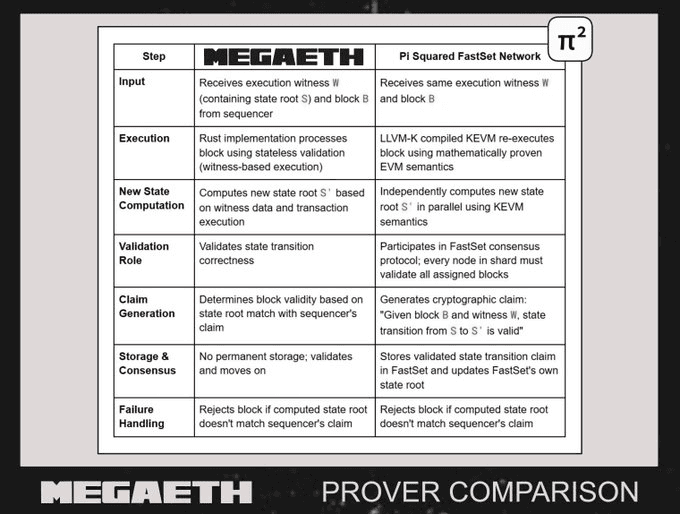
During block validation, MegaETH stateless validators and Pi Squared's FastSet Network work together simultaneously, both independently computing the new state root from the same witness data.
NOTE: FastSet is able to keep pace with MegaETH's 10ms blocks by running parallel instances that validate state transitions independently.
For a block to be considered valid, both the MegaETH stateless validators and the FastSet network must arrive at the same state root, creating a dual-client validation system where malicious state transitions would need to fool two independent implementations.
The Dual Validation Process
Conclusion
Stateless validation is the foundation that enables MegaETH to push the boundaries of latency, throughput, and execution without compromising on key properties of decentralization.
With Pi Squared, MegaETH achieves dual-client validation on day one—a level of redundancy most blockchains never reach.
We're making validation costs negligible and correctness mathematically guaranteed, bringing the endgame of consumer-grade throughput and cypherpunk ideals coexisting.
Published: 10/16/2025